
Trace Fulton County Former Owners
Former owners of a Fulton County property come together one recorded transfer at a time. Take the newest deed first. Name its grantor, then locate the instrument by which that same grantor acquired the tract. Repeat the process. No official online cutoff exists for the deed index. So a full property search runs through counter records, written requests, deed books, plats, and archive leads as one continuous workflow.
| Transfer point | Grantor to grantee | Deed clue | Book or page |
|---|---|---|---|
| Newest transfer | Latest seller to current buyer | Recording date and legal description | Copy from County Clerk |
| One step earlier | That seller's seller to that seller | Source-of-title reference | Prior book/page cited in deed |
| Older indexed step | Search both party roles and variants | Heir, commissioner, or sheriff notation | Clerk deed book or index |
| Pre-digital bridge | Compare deed and tax-roll names | Historic lot, acreage, or tax entry | Microfilm, plat, or archive source |
Treat the table as a blank chain method rather than a claim about any specific parcel. Every row gets filled from an instrument. Dates alone are never enough. The legal description, source of title, and party roles must keep pointing to the same land.
Reconstruct Fulton County’s Owner Chain
The Kentucky Department for Libraries and Archives deed-research method starts with a modern deed. Its source-of-title reference points to an earlier book and page. Then the process repeats. Search both grantor and grantee indexes, because spelling and indexing vary across deed records. "Grantor" names the party giving an interest. "Grantee" names the party receiving it.
- Obtain the latest deed for the subject tract and note its grantee, grantor, legal description, and prior book/page.
- Retrieve the cited prior deed. Confirm that its grantee is the later deed's grantor and that the land description matches.
- Search name variants in both indexes. Check spouse, trustee, executor, heir, commissioner, and sheriff entries.
- Continue into deed books, tax records, and plats when the public online route ends. Record each citation before moving back.
- Grantor
- The party conveying an interest in the recorded instrument.
- Grantee
- The party receiving the interest.
- Chain of title
- The ordered series of transfers affecting the same land.
- Reverse index
- An index organized by the receiving party, useful for finding an acquisition.
- Quitclaim and warranty deed
- Different conveyance forms; neither label alone proves a clean chain.
Fulton County Former Owner Clerk Route
The Fulton County Clerk deed page gives instructions rather than an online grantor-grantee search. It lays out what a deed carries. The fields include parties, consideration, legal description, source of title, preparation information, and return and tax-mail addresses. Those fields are exactly the clues that keep prior owners tied to one parcel.
The clerk publishes no public index screen, image charge, or earliest online year. Searching happens at the main Hickman counter. It is open weekdays at 2216 Myron Cory Drive, Suite 3. The Fulton branch sits at 101 Nelson Tripp Place and opens Wednesday. A written Open Records request can go in person, by mail, fax, or email. List the names, map number, book and page, legal description, and date range.
Note: The clerk's official deed route is shown on the recorder's own verified page.
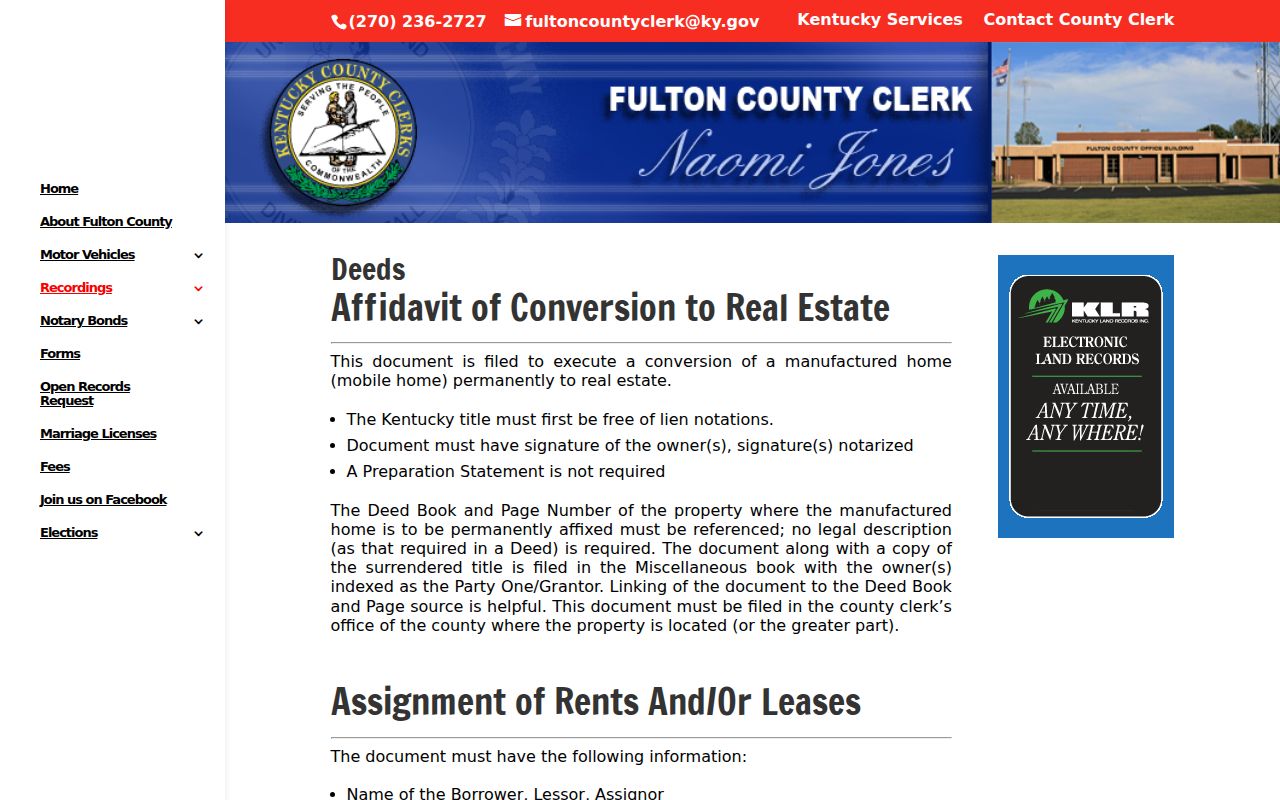
Shape your request around those deed fields, then build the owner chain from the records the clerk supplies.
Fulton County Prior Ownership Records
No official Fulton online deed index exists, so no web cutoff can be named. Say that plainly. It does not mean ownership records stop at any particular date. Older owners may still surface in clerk deed books, grantor and grantee indexes, recorded plats, KDLA material, and library microfilm.
No verified online cutoff. Do not assign Fulton County an invented first web year. Ask the clerk where the public screen ends and which book continues the chain.
KDLA's deed guide stands as the best state-level method source. It notes that deeds after about 1890 often cite prior recordings. Earlier tax records can bridge gaps. They help where a deed description runs thin. Confirm every bridge against the next available instrument.
Fulton County Tax Books Bridge Owners
A National Register bibliography for the Jesse Whitesell Farm cites Fulton County deed books. It also cites Fulton County Tax Assessment Books from 1855 through 1875 on microfilm at McCracken County Public Library. That is a strong lead. It is not a database, and it is not a promise that every year or parcel survives complete.
Ask the library for the exact roll or reel. Also ask whether names, acreage, and values are legible for your period. Set any tax-book name beside deeds on both sides of the gap. A tax roll supports the timeline, but it never replaces a conveyance. Label former owners as likely until the deed chain confirms them.
Fulton County Plats Trace Former Owners
Street addresses make weak keys in an old chain. Recorded plats and historic lot references can outlast address changes. The Buchanan Street National Register material names Old Hickman lots 357, 359 through 363, and 375 through 382. It also lists West Hickman lots 143 and 205. Those numbers can seed a clerk request.
Never paste an old lot number into a modern parcel field. Ask the clerk for the matching plat. Compare its streets and block. Then obtain the current PVA map number. Old Hickman's boundary clues include Clinton, Exchange, Obion, Moulton, and Kentucky streets. The connection has to be proved parcel by parcel.
Note: Historic lot numbers are search clues. Current ownership still requires a matching legal description and a recorded transfer.
Fulton Chain-Breaking Owner Entries
A plain buyer-and-seller pattern can break at death, foreclosure, tax sale, or court action. KDLA flags helpful index letters. H can signal heirs, C a commissioner, and S a sheriff. Read those entries as clues and verify the instrument itself.
Watch also for trustees, executors, alternate spellings, lis pendens notices, and commissioner or sheriff deeds. A deed's source-of-title reference may skip the name form a tax record would suggest. Probate or court files can explain why a representative conveyed the property. Still, the deed remains the key transfer in the land chain.
Fulton Railroad-Era Ownership Clues
Fulton's railroad past leaves a paper trail. County histories point to an 1857 railroad deed, trains arriving in 1859, and depot activity in the years after. Dates like these narrow a property search. They hint at where to look for deeds, easements, rights-of-way, and old tax-book entries. They cannot, however, prove who held a particular tract.
Working along the City of Fulton rail corridor? Request deed records and easement documents from that era. Then lay them beside plats, later city records, and the current legal description. Comparing sources this way can account for a narrow strip, a right-of-way exception, or an old depot-area boundary that a modern street search overlooks. The recorder and assessor each hold a piece of that story.
Where Fulton Prior Owners Survive
The County Clerk comes first for recorded land instruments. The deed books there name each owner of record. KDLA offers deed-research guidance and archive pathways. The Kentucky Historical Society County Records Files hold transcriptions, clippings, and photocopies arranged by county and topic for onsite use. They form no complete deed index.
Other stops help too. Fulton Public Library and the local historical and genealogical mailing lead can point to catalogs or county context. The FamilySearch Center at 501 Wells Avenue can help as well. Confirm hours, access, and holdings before you travel. Ask for an exact book, page, person, subdivision, or date whenever you can.
How Far Back Fulton Owners Go
The county publishes no first deed-book year. It lists no online cutoff and no record of courthouse loss. So do not assume a fire or a missing decade. The honest stopping point is whatever earliest instrument the clerk or the archive can produce for a tract.
From there, a former-owner chain works backward. Start with the current deed, then move into the clerk's books. Use plats, tax assessment books, and archive sources to frame each new request. Label every supporting record for what it proves. A Sanborn map may show a structure or a use. A tax book may name an assessed party. Only the conveyance trail in Fulton County property records establishes the true recorded transfer sequence.
Lawful use. Trace Fulton County former owners for house history, estates, and property diligence. Never use the record trail to stalk, harass, or harm a living person.