
Fulton County Deeds by Type
Fulton County deed records begin with an instrument filed at the County Clerk's real-estate recording counter. A deed names the parties. It states any required consideration, describes the land, and cites the source of title. Those details matter most. They connect a person or entity to one tract. The recorded chain gains a link, because the clerk also requires the preparer's name, the grantee's mailing address for the property tax bill, and signatures acknowledged before an authorized officer. That beats a name alone.
| Deed Type | What It Does | Common Use |
|---|---|---|
| General warranty | Conveys title with broad promises from the grantor | An ordinary arms-length transfer |
| Special warranty | Limits the grantor's promises to the grantor's own period | A transfer with narrower warranties |
| Quitclaim | Conveys only the interest the grantor may hold | Clearing or transferring a claimed interest |
| Correction deed | Corrects a stated error in an earlier instrument | Names, descriptions, or recording references |
| Commissioner's deed | Records a conveyance made under court authority | A judicial sale or court-directed transfer |
Mortgages, liens, releases, easements, and fixture filings sit beside deeds in the Fulton County land records, and each does a different job. A mortgage secures a debt. A lien asserts a claim. A release shows that a recorded claim has been discharged, while an easement grants a stated right to use the land. Recording alone does not settle every ownership dispute.
Fulton County's Recorder Counter
The Fulton County Clerk recording page is pictured below as an access reference.
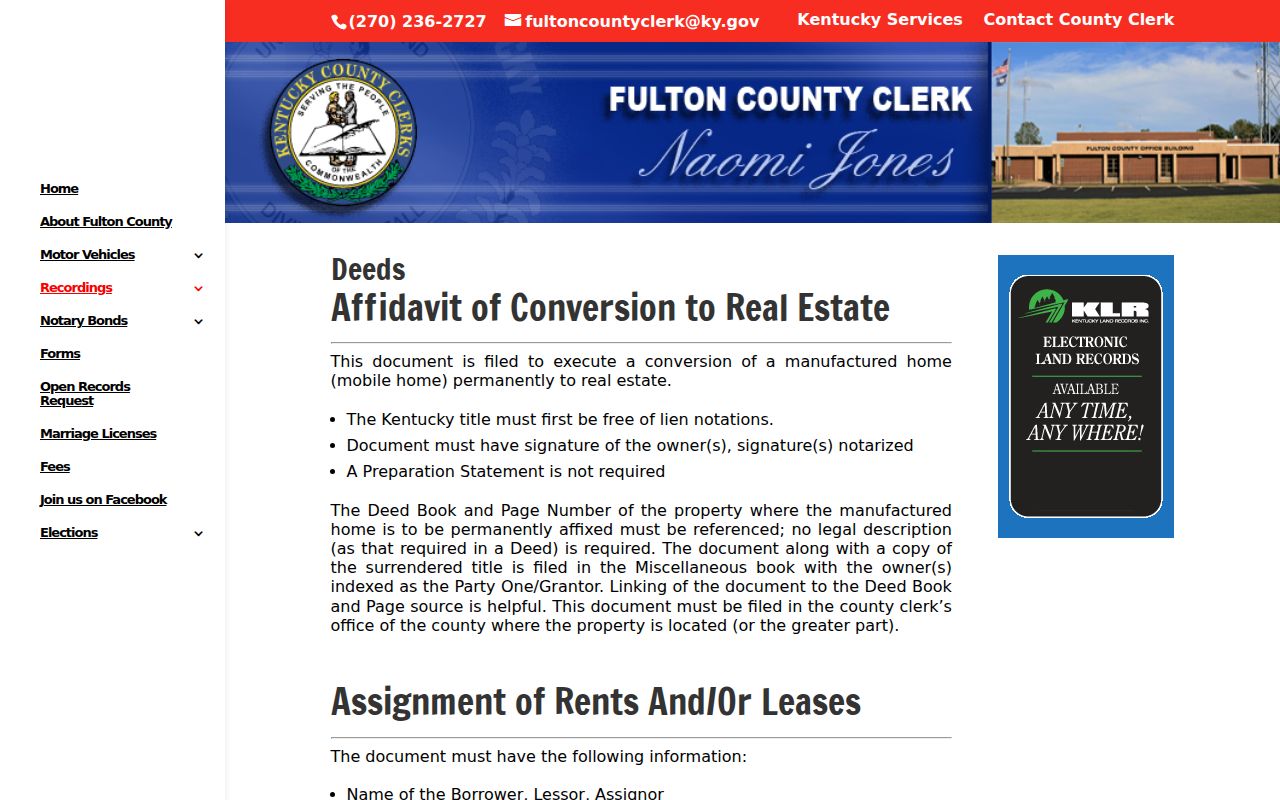
The Fulton County Clerk recording instructions are the main public starting point for deeds. The counter sits at 2216 Myron Cory Drive, Suite 3, Hickman, Kentucky 42050, and the office lists 270-236-2727. A branch at 101 Nelson Tripp Place in Fulton lists 270-472-3194 with Wednesday service. That branch helps residents who cannot make the Hickman trip. Confirm a specific deed-book search is available there before traveling.
The county publishes no public grantor-grantee search or document-image portal. That gap shapes the practical route. Bring names, an approximate transfer date, a map number, any legal-description clue, and a known book/page reference to the clerk. Ask whether the needed index, image, or volume waits at the counter. Also ask whether the Fulton branch can supply it.
Fields on Fulton County Deeds
The clerk's published requirements double as a request checklist. Expect a grantor, a grantee, and any stated consideration. A legal description and a source of title follow. The filing also names the preparer, carries acknowledged signatures, and gives the address where the grantee's property tax bill should be sent. These are requirements, not a promise that older deeds are clear or complete.
| Party names | The person, trust, estate, company, or other party conveying and receiving an interest |
|---|---|
| Consideration | The amount or value recited for the transfer, subject to Kentucky recording rules |
| Legal description | The land described by bounds, lot and block, subdivision, or another recorded reference |
| Source of title | The prior deed or record citation that points one step back |
| Return address | The address used to route the property tax bill, which may differ from the situs |
Copy every reference exactly. One wrong middle initial, company suffix, book number, or lot designation can pull the wrong instrument.
Tracing Fulton County's Deed Chain
Grantor and grantee indexes organize Fulton County deed records by who gave and who received each interest. The grantor sells. The grantee receives. Start with the latest verified owner and follow the source-of-title citations rather than trusting the tax-roll name to supply a complete chain.
- Obtain the newest deed in which the present claimant appears as grantee. Match its legal description to the target tract.
- Record the grantor, transfer date, deed type, and source-of-title citation. Do not rely on the mailing address as the land description.
- Search the prior party as a grantee in an earlier period. Repeat while the legal descriptions and source references keep matching.
- When the counter index ends, request the cited deed book, microfilm, or archive lead. Note any gap instead of guessing across it.
- Grantor
- The party transferring a stated interest.
- Grantee
- The party receiving that interest.
- Chain of title
- The linked series of recorded transfers for the same land.
- Book and page
- The volume and page where an instrument was entered before modern numbering systems.
Fulton Mortgages, Liens, and Releases
Deeds never tell the whole story. The Fulton County Clerk keeps separate instructions for mortgages, liens, and releases. Mortgage records identify the parties and the secured obligation. The published material also covers Mortgage Electronic Registration Systems references. The lien pages distinguish several filing types. They also explain the continuation rules that keep a claim alive. Release instructions cover satisfactions and releases of recorded claims. Search any name in both roles and across spelling variants. Then match each result to the parcel description and the recording reference. A release must tie to the exact mortgage or lien it discharges. A similar name alone proves nothing about the land.
Note: County-filed fixture and limited UCC records have a narrower scope than the Kentucky Secretary of State's UCC system.
Historic Fulton Deed Book Routes
Older Fulton County deed records are not lost just because they sit beyond any online index. Ask which index covers your year. The Kentucky Department for Libraries and Archives deed guide explains the grantor-grantee method and the role of deed books and microfilm. Counter staff can identify local volume references. KDLA can help locate state-held film. Historical collections add leads, not substitutes. A bibliography for the Jesse Whitesell Farm points to Fulton County deed books and tax assessment books from 1855 through 1875 on microfilm at McCracken County Public Library. The Kentucky Historical Society's Boyer Ferry account cites an 1857 plan of Hickman. It also cites page-specific county order books. Those clues can narrow a request. Riverfront, road, ferry, and early town property all leave these kinds of trails.
Railroad-Era Fulton Property Trails
Fulton's own city history adds an unusual wrinkle to any Fulton County property search. It records a railroad deed in 1857. The railroad itself arrived in 1859. Illinois Central activity came later. Land near tracks, depots, or old rights-of-way can carry traces of that era in the deed records and tax books. Search deeds, easements, and tax entries around those dates. Then compare the names and legal descriptions with later plats, maps, and recorded instruments.
The method works because street names and parcel lines change. A right-of-way reference can persist for generations. The history is a lead, not title evidence. Confirm every claimed transfer at the clerk's office or in the cited deed book. Hold an old city plan or National Register nomination to the same standard: both can help identify a place, but neither substitutes for the recorded deed.
Fulton E-Filing Needs Verification
A Kentucky legislative bulletin sets a firm deadline. County clerks were to provide an electronic filing portal for recorded instruments. They were to maintain it by January 1, 2024. Fulton publishes no vendor name and no public-search scope. There is also no word on whether electronic filing creates public image access. Filing and public retrieval remain separate functions.
Ask the clerk directly. Can a deed be submitted electronically? Can the public search any electronic index? Or do certified copies still require the counter or a written request? Never treat another county's service as the Fulton County service. Fulton offers no property-fraud alert signup. Owners should ask the clerk about current notification options rather than enroll through an unrelated county.
Fulton Open Records Requests
Some Fulton County deed records simply are not online. The Fulton County Clerk Open Records page lays out hand delivery, mail, fax, and email routes for these cases. A strong request identifies the requester. It should also describe the records in enough detail to locate them, state the desired format, and supply a way to respond. Kentucky's response window is five business days. State guidance puts standard paper pages at ten cents each. Other media and mailing may reflect actual cost.
For deed records, give both party names, an approximate date span, the property address, a map number if known, and any book/page citation. Ask for an estimate before ordering a large set. The clerk's posted fee schedule is dated 2020, so confirm current recording and copy charges before sending payment.
Getting a Fulton County Deed Copy
A plain deed copy serves research well. A certified copy bears the custodian's certification. It may be required for a formal filing or proceeding. The clerk offers no public image portal. Start at the counter or with a focused written request. Give the recording reference whenever you can. If only an address is known, pull the owner of record or map clue from the PVA first. Then ask the clerk to connect it to a deed index entry.
The clerk's posted 2020 fee schedule lists instrument and plat charges. However, it is not a current quote. Ask whether a search fee, copy fee, certification fee, postage, or advance payment applies. Be specific. Say whether you need a scanned research copy. Or say you need a certified paper copy of the deed records.
Recorded, not guaranteed. Fulton County deed records show instruments accepted for recording. They are not a title opinion, and unrecorded interests or unresolved claims may exist.